

LOCAL GOVERNMENT: PARTICIPATION OF WOMEN AND YOUTH SHOWS SLIGHT PROGRESS
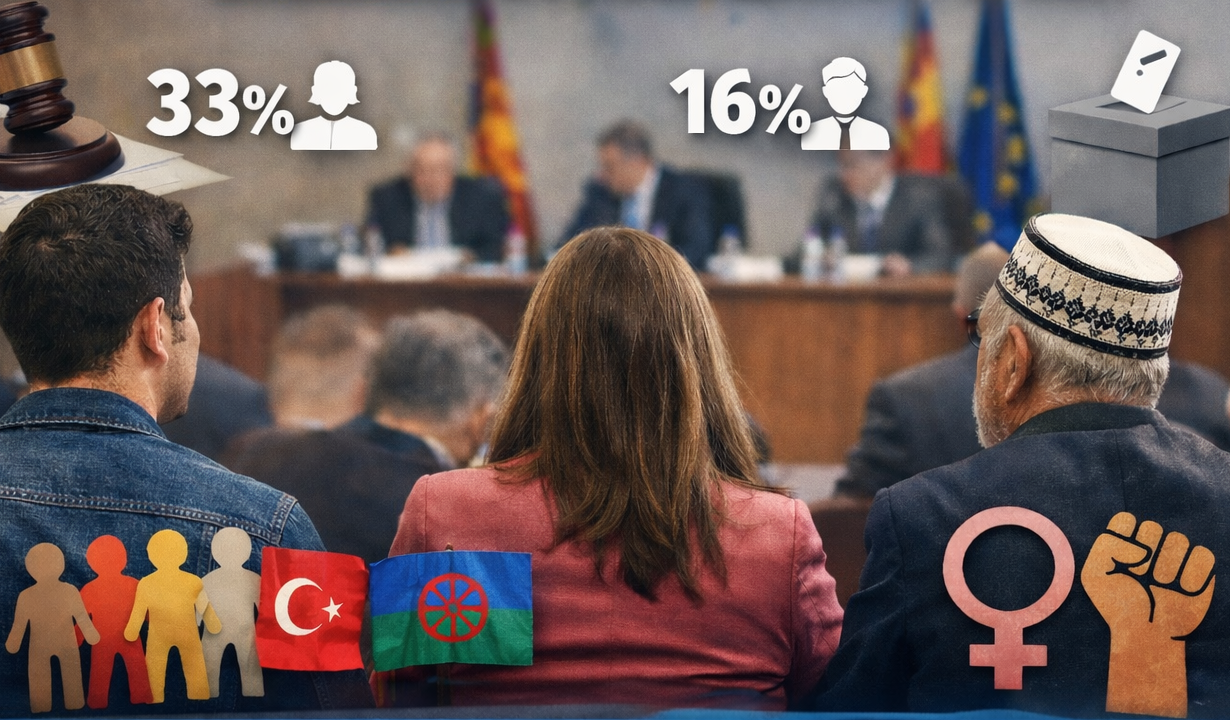

The latest research by the BIRC Institute on “The Representation of Women, Youth, and Smaller Ethnic Communities in Decision-Making at the Local Level,” conducted within the project “Voices of Equality: Democracy for All,” funded by the European Union, finds that the inclusion of these groups in the Pollog Region has become more formal than effective. Women, young people, and smaller ethnic communities are often placed on electoral lists to meet legal criteria, but their influence in decision-making remains limited.
THE FULL REPORT CAN BE FOUND HERE:
The research shows that women make up about 33% of elected councilors in the region. However, in several municipal lists their participation exceeded 40%. In Tetovo, women accounted for 45.25% of the candidates on electoral lists, but only 35.5% of elected councilors were women. In Gostivar, the figures were 43.62% on the lists compared to 34.8% in the municipal council. Even in smaller municipalities such as Jegunovce and Zhelina, participation on electoral lists remains high, but actual representation in decision-making differs significantly. The number of women running for executive positions also remains low: only 10.4% of candidates for mayor at the national level were women, and in the Pollog Region only two out of nine municipalities had female mayoral candidates.
Regarding youth, the report records strong contrasts. Only about 16% of elected councilors in the region are aged 18–29, but in smaller municipalities such as Jegunovce the percentage is much higher, with 54.5% of elected councilors being young people. This indicates that presence on electoral lists does not automatically guarantee real participation in decision-making, and that youth representation is often concentrated in smaller municipalities.
As for smaller ethnic communities, the report notes that their representation is often symbolic and channeled through ethnic parties or coalitions with major political parties. Roma and Turkish representation was seen in electoral lists and in several individual candidacies — for example the candidacy of Samka Ibraimoski — but the influence of these communities’ voices in local policies remains limited due to the lack of consultative mechanisms and resources.
The report also highlights a gap in public discourse: women and young people in the public sphere are most often associated with social issues and public services, but they rarely occupy leading positions in strategic debates at the local level. Even when campaigns promote inclusion through statements by local figures, the post-election reality shows that structural changes are still lacking.
As a key recommendation, the BIRC Institute calls for:
-
concrete mechanisms to transform formal representation into real influence (stabilizing quotas with clear implementation rules),
-
training programs and financial support for women and young people who run for office and engage in local politics,
-
policies to increase the visibility and voice of smaller ethnic communities through inter-ethnic councils and civil society organizations, and
-
continuous monitoring to measure progress and barriers. The report stresses that without these steps, formal representation will remain largely symbolic.
This research was funded by the European Union within the framework of the project “Voices of Equality: Democracy for All,” implemented by the Balkan Institute for Regional Cooperation – BIRC Tetovo. The project is a sub-grant awarded under the “EU Support to the Civil Society Resource Center – Phase 2,” funded by the European Union. The content of this research is the sole responsibility of the project implementers and does not necessarily reflect the views of the European Union or the Citizens Resource Center (GRC).