

IT BEGAN WITH A FAKE INSTAGRAM ACCOUNT AND ENDED IN REAL-LIFE STALKING: WOMEN IN NORTH MACEDONIA FACE VIOLENCE THAT DOES NOT STOP AT THE SCREEN

A fake Instagram account, manipulated photographs, sexual threats and stalking that extended into everyday life. Violence against women does not stop at the screen of a phone. In North Macedonia, the experiences of women and young girls reveal the scale of this phenomenon: 44% of them feel unsafe in digital spaces, while 86% of women and girls who have experienced or witnessed online violence or harassment have not reported the incident. Meanwhile, the Ministry of Interior does not categorise online harassment cases separately in its statistics.
By: Enis Shaqiri
A spoon she had used to stir her coffee. A glass from which she had drunk water. Ordinary objects from a visit to a café that, for most people, would simply have been part of a normal day. But not for Era, a 23-year-old woman from Skopje whose name has been changed to protect her identity.
For six months (February – July 2026), she faced threats, manipulated photographs and stalking that was not confined to social media but extended into her everyday life.
“I felt so bad that I was on the verge of losing all hope of living. He saw me simply as a sexual object and threatened me constantly, telling me: ‘I would lock you in a basement, where I would give you nothing but water and sex’,” Era, a university student, tells the BIRC Institute.
“It all started on Instagram”
According to Era, everything began when a man in his forties created a fake Instagram account using her name.
“He used an account under my name, and later also several personal photographs of mine that had been manipulated using ‘Photoshop’ or ‘AI’ (artificial intelligence). I am not exactly sure which. He used them as a means of threatening me,” she explains.
At first, she tried several times to have the account removed, but the person kept creating new ones. Realising that this was not stopping him, Era tried to reach an agreement with him, hoping that the photographs would be deleted. For this reason, as she explains, their communication was not particularly aggressive at the beginning. However, the situation changed after she refused several of his demands.
“He wanted me to undress in front of a camera or meet him in person. After I refused these demands, things took a different turn and developed into stalking by this individual. He knew a lot about me. He had been following me on Instagram for years, and more recently on Facebook and Snapchat, and even in my everyday life,” says the student, who also works promoting jewellery.
According to her, the stalking went beyond monitoring her accounts and communicating with her through social media.
“Imagine, he had even kept the spoon I had used to drink coffee and the glass I had drunk water from at a café. He bought every perfume and item of clothing that I promoted through my marketing work,” she recounts.
Her case highlights another documented problem. A study conducted in 2025 and published in July 2026 by the OSCE Mission to Skopje shows that 44% of women and girls aged 18 to 29 feel unsafe in digital spaces.
The research was conducted using a representative sample of 600 female respondents from all planning regions of the country.
Around one in ten respondents had personally experienced some form of gender-based violence in digital spaces, while 15% had witnessed such an incident.
According to the research, the most frequently reported forms of abuse include:
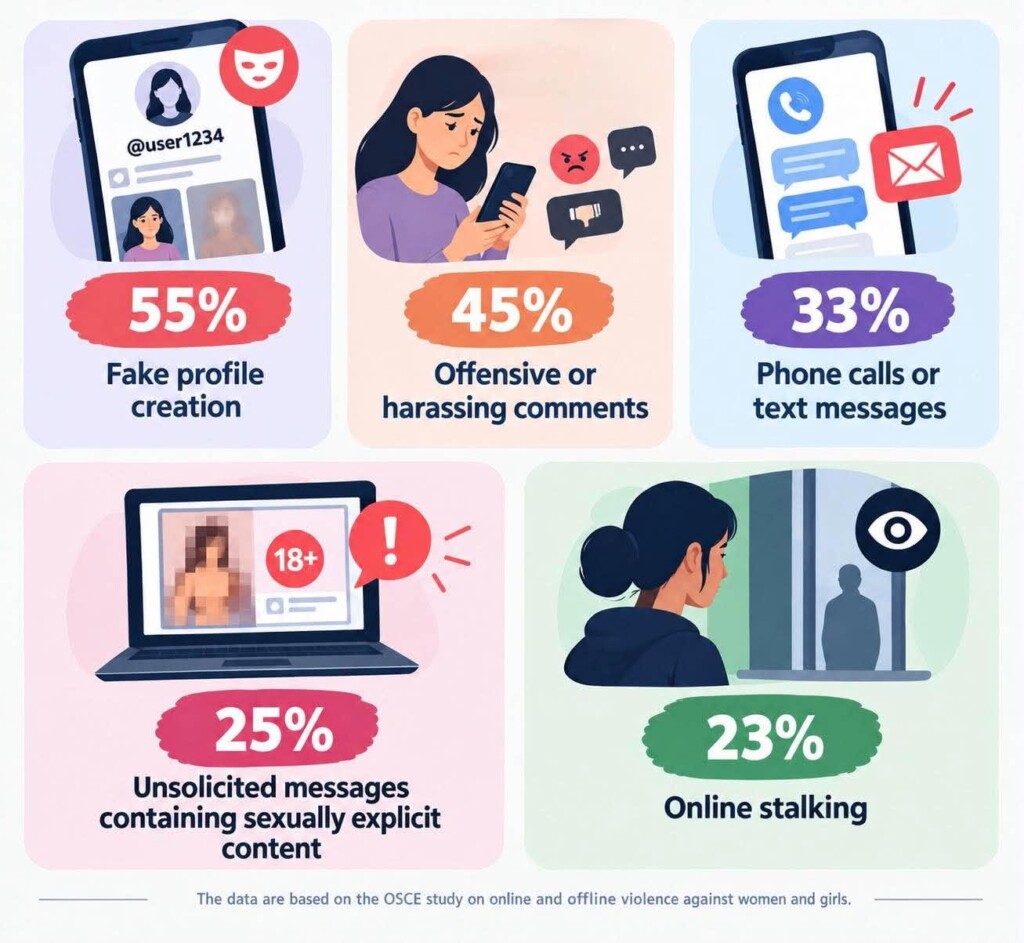
One of the most concerning findings of the research is the low level of reporting. As many as 86% of women and young girls who had experienced or witnessed gender-based violence or harassment in digital spaces had not reported the incident. Only 10% said they had reported it. Most commonly, reports were made to the police or directly to the social media platform where the abuse had occurred.
“Being a girl is not easy”
Era had experienced this feeling herself. She did not disclose whether she had reported the case to the police, but says she showed the conversations to her family and later shared them on her private Instagram account.
“I also received support on social media because I had the courage to show everyone what he had been doing to me for six months, without stopping.”
“After some time, they understood the situation. I have talked about this issue a lot. Many girls understand that these cases happen frequently, because many men do not understand or respect a woman’s refusal. I received the greatest support from my close circle of friends. My family did not understand what it means to be a girl and to face someone who stalks you and adds to your stress and dark thoughts every day,” she concludes.
Fear, distrust and lack of information
The report also identifies several key barriers that discourage women from reporting violence, with lack of information and distrust in institutions emerging as the leading factors:
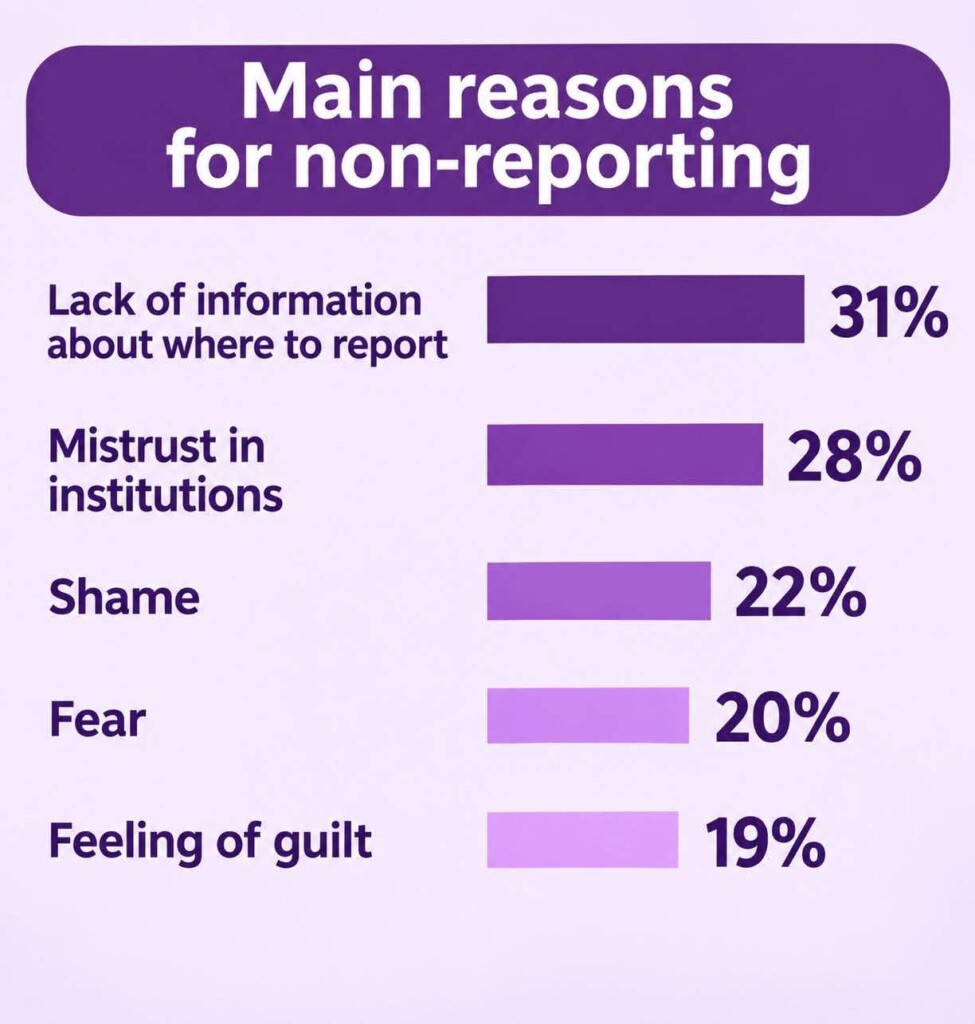
Perceptions of institutions are also mixed. Trust is higher in educational and healthcare institutions, while it is lower in the judiciary and the Public Prosecutor’s Office.
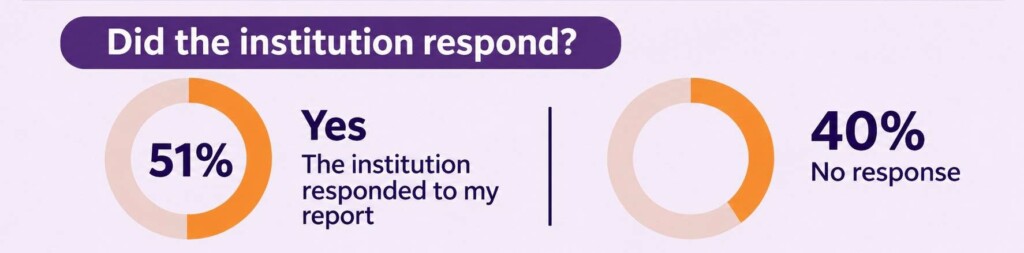
According to the study, the main shortcomings identified by victims and witnesses include inadequate punishment of perpetrators – 65%, insufficient protection and support for victims – 56%, and slow institutional responses – 55%.
The report’s qualitative findings also show that some victims, after seeking help, are advised to ignore the insults. The lack of clear reporting mechanisms, slow police responses, lengthy procedures and difficulties in securing evidence make it harder to pursue these cases.
The Ministry of Interior does not categorise online harassment cases separately
Despite the ongoing visibility of this problem, North Macedonia’s Ministry of Interior (MoI) does not list cases of technology-facilitated harassment separately in its statistics.
Nevertheless, data on domestic violence obtained by the BIRC Institute from the Ministry of Interior show an increase in the number of reported cases during the January–June 2026 period, compared with the same period last year.
During this period, 528 cases were registered, compared with 517 a year earlier, representing an increase of approximately 2.1%. The number of victims reached 555, up from 540 in the first six months of 2025, marking an increase of approximately 2.8%.
The data show that 490 of the registered perpetrators were men and 43 were women. Regarding family relationships, the perpetrators were husbands in 209 cases and wives in 11 cases.
The lack of disaggregated data also makes it difficult to assess how these cases are handled: how many are investigated, under which criminal offences they are classified, how many reach the Public Prosecutor’s Office and what protection is provided to victims.
“Technology also affects societies shaped by the ‘Kanun’”
For sociologist and university professor Ali Pajaziti, violence against women in digital spaces cannot be separated from the social norms and power relations that continue to exist in society.
Speaking to the BIRC Institute, he says that patriarchal beliefs and the idea of male dominance over women continue to influence how relationships between the sexes are perceived.
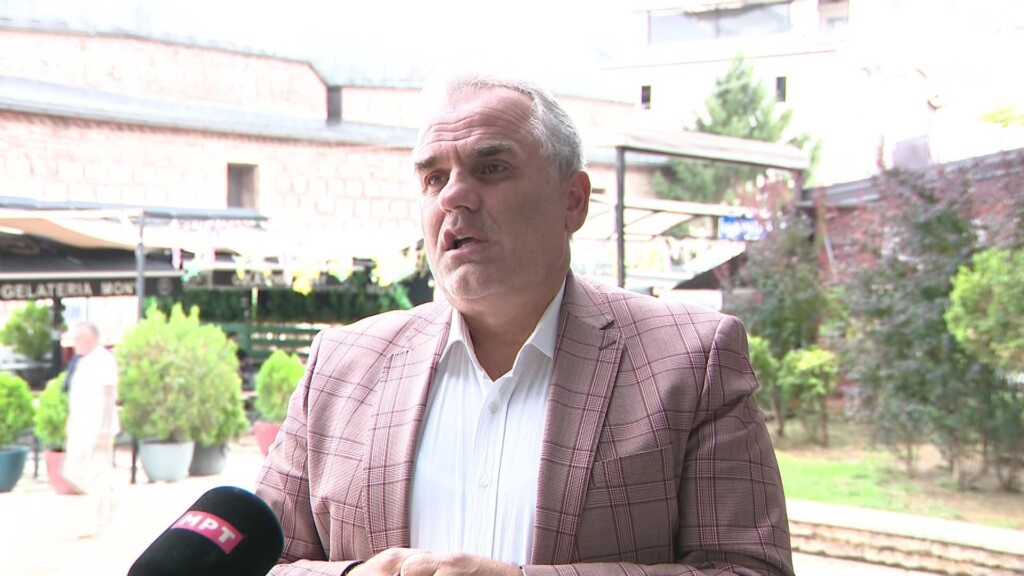
“Unfortunately, this is a trend that continues to this day, even in a society that aspires to justice, where Balkan women, including Albanian women, continue to be targets of pressure, oppression and even cyber violence, which harms their dignity and psychological well-being and hinders their advancement in society,” Pajaziti says.
According to him, technology has given perpetrators new opportunities to exert pressure, control and threats against women, even when they are not physically near them.
“A man who feels stronger can now have even the most distant woman in the palm of his hand through technology – mobile phones and other tools he has access to – and can send destructive messages to a woman he has chosen as his target,” he adds.
“There is still this conventional belief that men are stronger and more powerful, and that women should submit to their wishes whenever they want,” he concludes, emphasising the need to stand up for women and for every individual whose privacy has been violated.
The problem also affects children
This phenomenon does not affect only young women. A study by Safe Online, published in August 2026, with support from UNICEF, estimates that 11,727 children aged 12 to 17 who use the internet in North Macedonia, or 9.4% of this population, have experienced at least one form of technology-facilitated sexual exploitation or abuse.
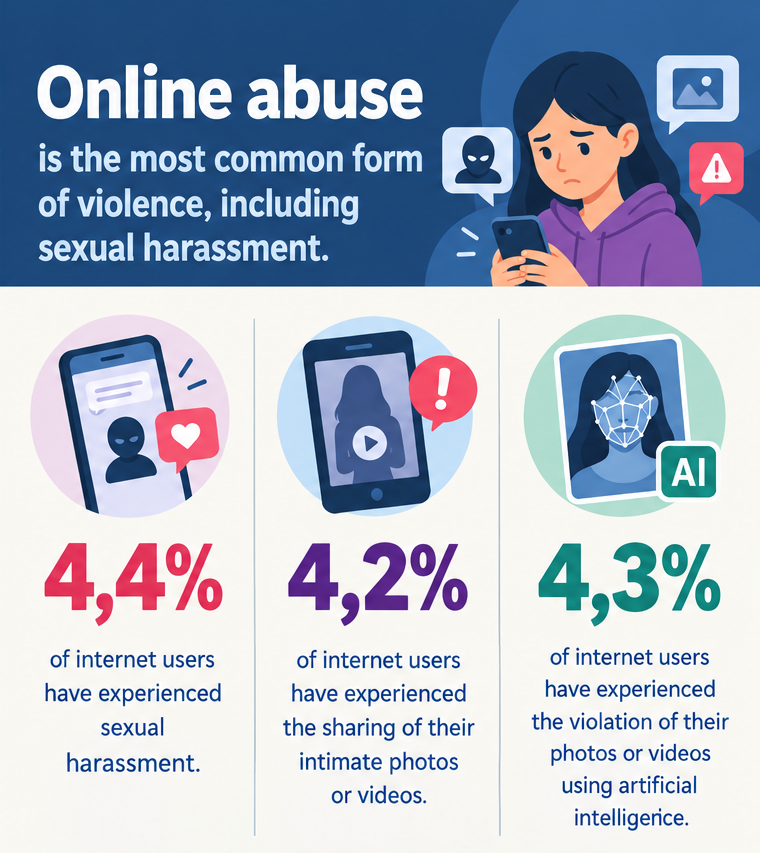
In the comparative analysis of the nine countries included in the second round of the study, North Macedonia had the highest percentage of children who reported being threatened or blackmailed into participating in sexual activities.
“The absence of reports does not mean the absence of violence”
In February 2026, Minister of Education and Science Vesna Janevska announced that 34 reports of violence had been received during the school year, but none had been categorised as online violence.
Janevska stressed that the absence of reported cases does not mean that online violence is not present, and called on young people to report every such incident.
“As a Ministry, we encourage all students, both girls and boys, to report violence in any form. They can do so by emailing [email protected], contacting the Pedagogical Service directly or reporting it to the State Education Inspectorate,” Janevska stated.
From the 2024 declaration to the measures announced in 2026
Digital violence is not a new phenomenon, and institutions have been announcing measures to address it for years.
In December 2024, the country’s President, Gordana Siljanovska-Davkova, the Ministry of Education, youth organisations and civil society organisations signed a Declaration of Intent containing ten action points aimed at combating violence against women and young girls. It envisaged awareness-raising, education, training, data collection, support services, youth participation, as well as institutional and legal reforms.
Meanwhile, in 2026, the Ministry of Social Policy, Demography and Youth published the working draft of the National Strategy for the Prevention and Protection against Gender-Based Violence against Women and Domestic Violence 2026–2033, together with the 2026–2029 Action Plan.
The strategy aims to establish a more coordinated framework for preventing violence, protecting victims and ensuring institutional accountability. However, according to experts, the decisive factor will be the implementation of concrete measures, including the identification and adequate handling of technology-facilitated violence.
Reporting and support for victims
For cases involving computer crime, the Ministry of Interior provides the option of reporting to the Sector for Economic and Computer Crime in Skopje, at the MRTV building, or at the nearest police station responsible for handling such cases.
Cases can also be reported via the email address [email protected], although they are not subsequently categorised as “online violence”.
In cases of immediate danger, citizens can contact the police by calling 192.
According to the Ministry of Interior, it is important for victims to preserve digital evidence, including screenshots, links to profiles and posts, messages, dates and times of communication, as well as any information that could help identify the person responsible. Before deleting a profile or blocking an account, victims should preserve any material that could serve as evidence.
From the screen to real life
Era’s story shows that digital violence does not necessarily remain confined to an online platform. A fake Instagram account was followed by threats, the use of manipulated photographs and stalking which, according to her, continued in everyday life.
Her case comes at a time when the European Commission’s 2025 Report on North Macedonia also highlights challenges in implementing the Istanbul Convention, a Council of Europe instrument aimed at preventing and combating violence against women and domestic violence. The Commission points to gaps in legislation, insufficient funding for services and the need to strengthen institutional capacities.